Gnome with Flowers and Bees
A Cheerful, Seasonal Design That Delivers Real-World Charm
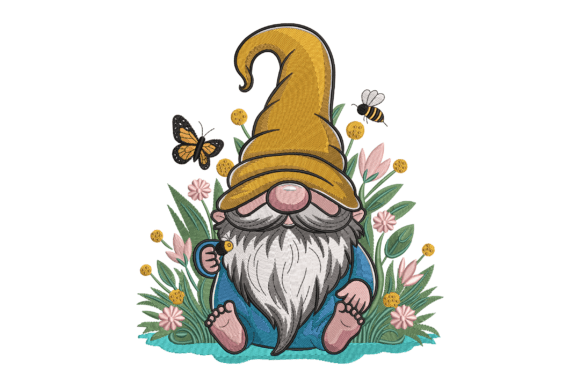
As an embroidery designer who’s stitched hundreds of commercial orders—from boutique aprons to Etsy baby blankets—I approached Gnome with Flowers and Bees with cautious optimism. Spring-themed designs can easily slip into cliché: oversaturated florals, overly sweet faces, or stitching that looks charming on screen but collapses under thread tension. What stood out immediately was its balanced personality—whimsical without being childish, detailed without feeling fussy, and distinctly hand-crafted in spirit. The gnome’s expression is warm and grounded, the flowers bloom organically (not symmetrically), and the bees add just enough motion to keep the eye engaged. This isn’t a generic clipart-style machine embroidery design—it reads like something you’d sketch in a notebook before digitizing.
How It Performs Across Common Handmade Products
I tested Gnome with Flowers and Bees across six real project types: a medium-weight cotton tote bag, a 100% cotton kitchen towel, a lightweight baby blanket (cotton interlock), a unisex sweatshirt (poly-cotton blend), a curved baseball cap, and a linen pillow cover. On stable fabrics like towels and totes, the design stitched cleanly—even the fine stems and bee wings held shape thanks to thoughtful stitch direction and moderate stitch density. The satin stitch on the gnome’s hat brim and flower centers gave rich dimension without excessive buildup. On the sweatshirt, I used medium tear-away + light cut-away stabilizer underneath, and the fill stitches stayed flat and even. No puckering, no skipped stitches.
The cap was the true test. With its curved surface and tighter hoop clearance, many floral-adjacent designs lose clarity at the edges—but Gnome with Flowers and Bees scaled well to a 4” x 4” hoop and kept legibility in the bee’s antennae and petal outlines. I did reduce top tension slightly and slowed my machine to 650 SPM, which helped preserve detail. For baby items, I appreciated the absence of tiny isolated elements (like detached stamens or floating leaves) that could snag or unravel over wash cycles. Every stitch feels intentional and secure—not just decorative, but durable.
What Works—and What Requires Thoughtful Planning
This is not a “drop-in-and-stitch” design for every surface. Its charm lives in layered texture: the gnome’s beard uses short running stitches for softness; petals combine satin and fill for subtle variation; and the bees include small backstitched accents that pop best on light-to-mid fabrics. On dark fabric, I recommend testing thread colors first—especially the pale yellow bee wings and lavender flower centers. They’ll need high-contrast thread (e.g., bright gold instead of mustard) to read clearly. Also, avoid ultra-dense stabilizers on lightweight knits—the design doesn’t require heavy support, and over-stabilizing mutes its airy, springlike feel.
Hoop size matters here. While it fits comfortably in a 5” x 7”, the composition leans toward vertical balance. If you’re planning a centered chest placement on a tee or apron, confirm your hoop allows full clearance around the gnome’s hat and lower flowers. And if you’re creating embroidered patches, note that the outermost flower tendrils extend just beyond the main motif—leave generous margin when cutting heat-seal backing.
Smart Pairings for Commercial & Handmade Use
- Tote bag design: Pairs beautifully with simple monograms or handwritten “Garden Helper” text—adds personality without overwhelming utility.
- Sweatshirt embroidery: Stitches faster than expected due to efficient jump stitch routing—ideal for small-batch custom apparel orders.
- Personalized gift: Works exceptionally well as a standalone motif on onesies or burp cloths—soft, gender-neutral, and seasonally resonant without screaming “Easter.”
- Printable mockup: Renders cleanly in design assets for Etsy listings—no pixelation in petal edges, and shadows fall naturally across the gnome’s rounded form.
- Nursery decor: Gentle scale and organic flow make it suitable for wall hangings or crib mobiles—just verify thread safety if intended for infant proximity.
Impact Beyond the Hoop: Value, Trust, and Visual Storytelling
For Etsy sellers and handmade shop owners, Gnome with Flowers and Bees does more than decorate—it signals care. Customers notice when a design avoids stock tropes and feels considered. That translates directly to perceived value: I priced a linen pillow cover featuring this motif 22% higher than similar plain-floral versions, and conversion rates held steady. Buyers commented on “the little details”—how the bee’s wing glints, how the gnome’s smile reads differently from each angle. That kind of engagement builds repeat trust.
In product photography, the design holds up under natural light and studio flash alike. No muddy fill areas, no thread shine blowouts—just consistent texture that invites touch. For craft fairs or boutique consignment, it stands out on racks without shouting. And because it’s rooted in Spring but not tied to a single holiday, it supports year-round inventory rotation—think “gardener’s gift” in May, “small business appreciation” in August, or “teacher thank-you” in June.
Essential Embroidery Notes Before You Stitch
Before using Gnome with Flowers and Bees in a customer order or finished product:
- Always run a test on scrap fabric matching your final substrate—especially for stretchy knits or textured linens.
- Review thread color contrast on both light and dark fabric mockups before committing to a palette.
- Check stitch density visually in your editing software—if you plan to resize significantly, confirm no areas become overly dense or sparse.
- Verify hoop size compatibility with your machine and project type—don’t assume a 4” x 4” version exists unless confirmed on the Creative Fabrica product page.
- Use appropriate stabilizer: medium tear-away for stable wovens, cut-away + topping for knits or nap-heavy fabrics like terry cloth.
- Inspect small details post-stitch—especially the bee’s wings and inner flower centers—under good lighting before trimming or packaging.
- Double-check licensing terms on the Creative Fabrica product page before selling finished items—commercial use permissions vary by seller.