Minimalist Flowers: A Designer’s Real-World Review
First Impressions: Quiet Charm, Strong Intent
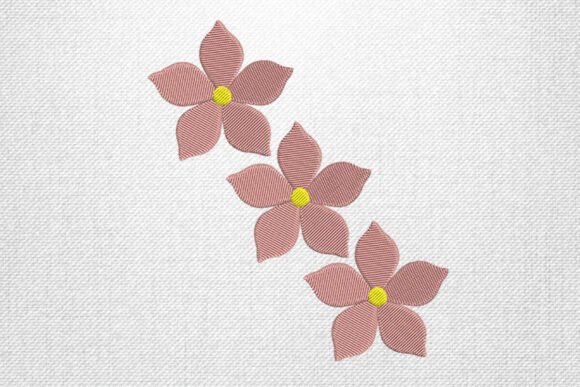
When I opened Minimalist Flowers on Creative Fabrica, I wasn’t looking for another floral filler—I was scouting for a design that could elevate a small-batch tote line and hold up in an Etsy listing next to hand-drawn botanicals. What stood out immediately wasn’t complexity, but intentionality: a clean row of soft pink blooms with subtle yellow centers, spaced just wide enough to breathe. There’s no heavy fill stitch clutter, no ornate vines or overlapping petals—just confident negative space and gentle curves. As a machine embroidery designer who routinely edits stitch paths for commercial production, I appreciated how the design’s “stitching personality” leans into satin stitch definition for petal edges and light fill for centers—not dense, not sparse, but calibrated for clarity at 3–4 inches wide.
Fits Naturally Where Simplicity Sells
Minimalist Flowers belongs in the Bouquets Bunches category, but it doesn’t behave like a traditional bouquet. It’s linear, rhythmic, and quietly directional—ideal for hemlines on baby blankets, sleeve cuffs on organic cotton sweatshirts, or the lower corner of a linen kitchen towel. I tested it as a sweatshirt embroidery placement (left chest, ~3.5" wide) and found it balanced perfectly against the garment’s relaxed drape—no visual heaviness, no competing texture. On a curved cap front? It held shape well when hooped with medium-cutaway stabilizer and stitched at reduced speed. For pillow covers and aprons, its horizontal flow adds subtle rhythm without demanding attention—exactly what boutique buyers respond to in curated home goods.
Real-World Performance Across Fabrics & Forms
Here’s where Minimalist Flowers earns trust:
- Stretchy fabric: Works cleanly on lightweight French terry and slubbed jersey when paired with tear-away + light cutaway stabilizer—no puckering around petal curves.
- Dark fabric: The soft pink thread reads clearly on charcoal and navy; yellow centers pop without glare. Always test contrast on your exact fabric batch—dye lots vary.
- Tiny details: No micro-lettering or fragile stems to snag during washing. Petal outlines are generous enough for reliable satin stitch coverage, even on textured weaves like unbleached canvas or waffle-knit towels.
- Hoop size: Fits comfortably in a 4"x4" hoop—critical for small-run custom apparel and embroidered patch production. No re-hooping needed for standard placements.
Commercial Use: Value, Trust, and Visual Consistency
As someone who sells finished embroidered goods and digital embroidery files alike, I pay close attention to how a design affects perceived value. Minimalist Flowers subtly raises the handmade bar—not through intricacy, but through restraint. Customers notice the quiet confidence in its spacing and color balance. That translates directly to stronger product photography (clean backgrounds let the motif shine), higher engagement on Instagram carousels, and improved conversion on Etsy listings tagged “minimalist gift” or “neutral nursery decor.” For craft fair vendors or local boutiques, this design helps unify a collection: same motif, different applications—pillow cover, tea towel, baby onesie—reinforcing brand consistency without repetition fatigue.
What to Check Before You Stitch
Before committing Minimalist Flowers to a customer order or wholesale run, I always verify these five points:
- Test on scrap fabric using your exact thread colors and stabilizer combo—especially for baby items or kitchen textiles that face frequent washing.
- Review stitch density in your embroidery software. If the file includes layered elements (e.g., optional stem lines), confirm they’re optimized—not over-stitched—for your machine’s needle tolerance.
- Confirm hoop size and placement matches your intended product: a 3.75" version may be perfect for a cap, but too narrow for a full-tote side panel.
- Compare mockups on light and dark fabric before finalizing thread choices—soft pink behaves differently on ivory vs. oatmeal linen.
- Read the licensing terms on the Creative Fabrica product page before selling finished products. Some Embroidery files allow unlimited physical use; others restrict resale of digitized versions. Clarity here protects your small business.
Where It Shines—and Where to Pause
Minimalist Flowers excels in personalized gifts (monogram + motif combos), seasonal handmade collections (think Easter egg towels or spring baby blankets), and printable mockups for digital product sellers. Its restrained palette makes it easy to coordinate with neutral thread palettes across multiple projects—cutting down on color switching time in production. That said, if you need bold scale (e.g., 8"+ focal pieces), dramatic texture (raised puff or chenille), or complex applique layers, this isn’t the design. It’s not meant to dominate—it’s meant to harmonize.
A Thoughtful Addition to Your Design Assets
In my studio, Minimalist Flowers has become a go-to for clients who want “elegant but not fussy,” “handmade but not rustic,” “modern but not cold.” It bridges gaps between generations of buyers—grandmothers ordering nursery decor, Gen Z customers curating capsule wardrobes, Etsy shoppers searching for “quiet luxury” accessories. It’s not flashy, but it’s memorable in the right context: a single row of blooms stitched just so, anchoring a handmade product with intention. If your work values clarity, wearability, and quiet sophistication—and if your customers respond to thoughtful detail over decorative noise—Minimalist Flowers is worth adding to your active design assets. Just remember: stitch smart, stabilize appropriately, and always match the motif’s calm energy with equally considered execution.